Buy lthorses.eu ?
We are moving the project
lthorses.eu .
Are you interested in purchasing the domain
lthorses.eu ?
domain@kv-gmbh.de · 0541-91531010
Buy lthorses.eu ?
What are geometric patterns?
Geometric patterns are repetitive designs or motifs that are created using geometric shapes such as lines, circles, triangles, squares, and other geometric elements. These patterns can be found in various forms of art, architecture, textiles, and nature. Geometric patterns are characterized by their symmetry, order, and precision, and they are often used to create visually appealing and harmonious compositions. **
What are geometric quantities?
Geometric quantities are measurements or properties of geometric figures or shapes. These quantities can include length, area, volume, angles, and curvature. They are used to describe and analyze the characteristics of geometric objects in mathematics and physics. Geometric quantities play a crucial role in various fields such as engineering, architecture, and computer graphics. **


Similar search terms for Geometric
Top-Angebote
Products related to Geometric:
-
Nuloom Casual Geometric Indoor/ Outdoor Geometric Striped Area RugWhoever said beautiful floor accents are only for inside the home hasn't yet met an indoor/outdoor rug. Each unit is designed to stand up to the elements while adding a touch of charm to your surroundings.63,11 $*Shipping: 0,00 $Secure redirect to the provider
-
StayWell Aluminum Alloy Swinging Rope, Durable Gym Equipment For Strength Training Aluminum Alloy Swinging Rope, Durable Gym Equipment For Strength Training"Elevate Your Strength Training with the Compact Steel Fitness Rope Designed for fitness enthusiasts seeking efficient and spacesaving equipment, this 15.7""inch ropefree training rope is a gamechanger for home and commercial gyms. Key Features:..."56,97 $*Shipping: 0,00 $Secure redirect to the provider
-
Victorinox Swiss Army Knife EquestrianThe Victorinox Swiss Army Knife Equestrian is the perfect pocket companion for passionate riders. Designed with equine enthusiasts in mind, it features a compact yet highly effective hoof cleaner, making it ideal for use after rides or while working around the yard. In summary, this knife is portable, practical, and ready to tackle any equine challenge. Tools: Blade, large / Bottle opener / Can opener / Corkscrew / Hoof cleaner / Keyring / Reamer and punch / Screwdriver 5mm / Toothpick / Tweezers / Wire stripper / Wood saw Dimensions: 1.8(H) x 11.1(L) x 3.2(W) cm. Weight: 0.125kg. The Victorinox Swiss Army Knife Equestrian is covered by a Victorinox lifetime warranty. Knives are not for sale to persons under the age of 18. - all knives and bladed products are delivered by Age Verified Delivery (AVD). The carrier may request proof of age in order to deliver your parcel. If proof of age is not available, or the recipient is underage, the carrier will refuse to deliver.57,95 £*Shipping: 0,00 £Secure redirect to the provider
-
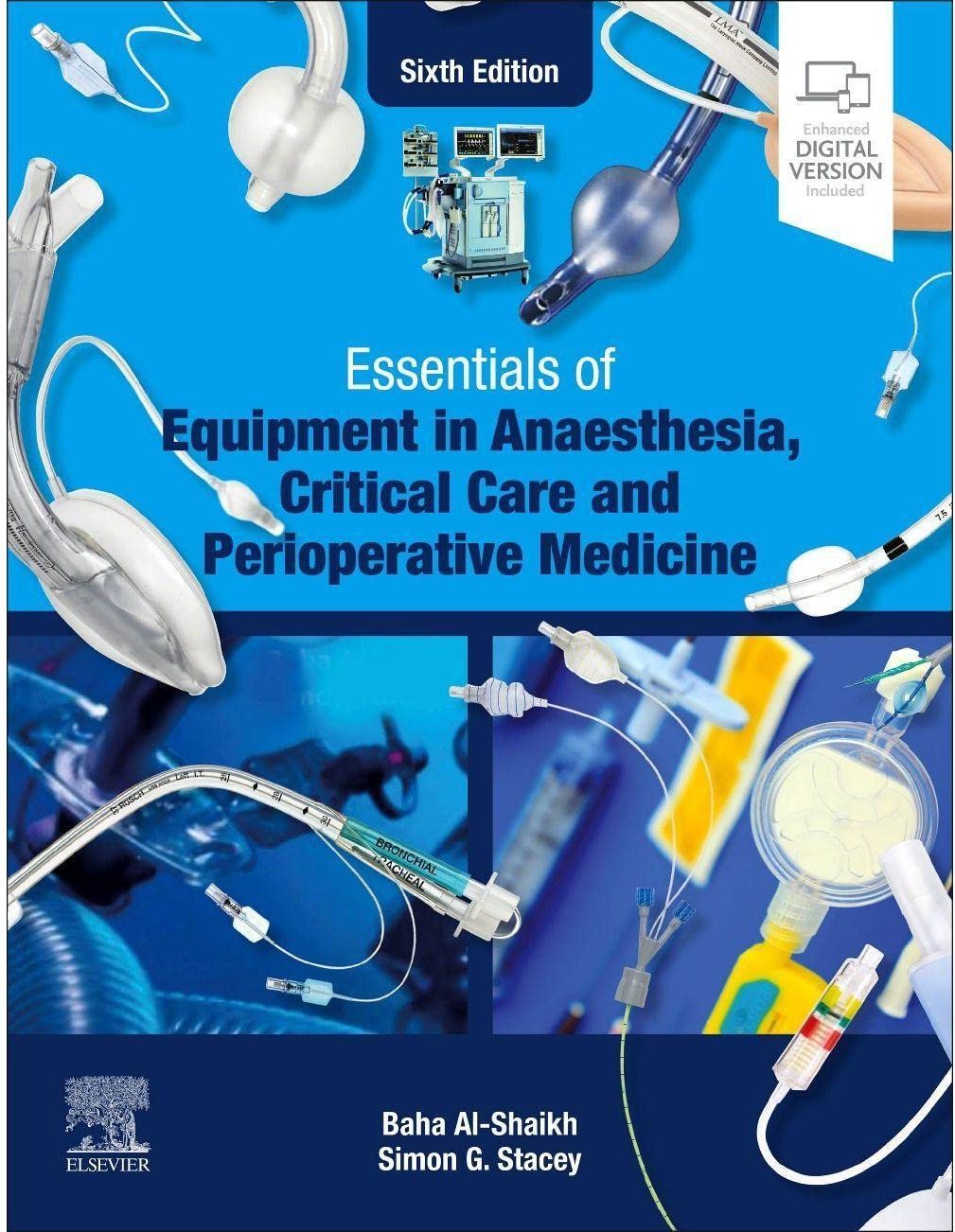
Elsevier Essentials of Equipment in Anaesthesia, Critical Care and Perioperative MedicineEasy to read and follow, Essentials of Equipment in Anaesthesia, Critical Care and Perioperative Medicine makes an otherwise dry subject digestible and easy to learn. This practical textbook comprehensively covers all the equipment used in the operating theatre and intensive care unit, including why it is used and any related safety concerns. It has been fully updated in its sixth edition to include new technologies introduced during the Covid-19 pandemic. This is ideal as the main text for all trainees undertaking the primary FRCA exams and is also suitable anyone who works with anaesthetic equipment, including anaesthetic and intensive care nurses and operating department practitioners. It features concise and consistent text and illustrations, self-assessment features, and exam tips. Portable, concise and simply formatted - a perfect practical companion Clear coloured images and illustrations bring the text to life Follows the Royal College of Anaesthetists postgraduate training and exam syllabus Summary boxes, more than 100 exam style questions, and OSCE stations and exam tips all aid the reader in exam revision Covers new equipment and fully updated relevant to current practice Suggested further reading fully updated New information on: Aladin Cassettes; Glostavent machine; CONTRAfluran system; videolaryngoscopy and high definition camera use in intubation and endoscopy; use of ultrasound in epidural; Penthrox; NRFit devices; Cell saver; ECMO38,99 £*Shipping: 0,00 £Secure redirect to the provider


-
What geometric shapes are there?
There are many geometric shapes, including circles, squares, rectangles, triangles, pentagons, hexagons, octagons, and more. **
-
What is a geometric sequence?
A geometric sequence is a sequence of numbers where each term after the first is found by multiplying the previous term by a constant factor. This constant factor is called the common ratio. For example, in the sequence 2, 6, 18, 54, the common ratio is 3 because each term is obtained by multiplying the previous term by 3. Geometric sequences can be represented by the formula an = a1 * r^(n-1), where a1 is the first term, r is the common ratio, and n is the term number. **
-
What is a geometric equation?
A geometric equation is an equation that involves geometric figures such as points, lines, angles, and shapes. These equations often describe the relationships between the various elements of a geometric figure, such as the lengths of sides, the measures of angles, or the properties of different shapes. Geometric equations are used to solve problems related to geometry and are fundamental in understanding the properties and relationships of geometric figures. **
-
What is the geometric problem?
The geometric problem refers to any issue or challenge related to the study of shapes, sizes, and properties of objects in space. This can include problems related to finding the area, perimeter, volume, or angles of various geometric figures, as well as problems involving transformations, congruence, similarity, and other geometric concepts. Geometric problems often require the use of mathematical reasoning and visualization skills to solve. **


How do you calculate geometric shapes?
Geometric shapes can be calculated using various formulas depending on the shape. For example, the area of a rectangle is calculated by multiplying its length by its width, while the area of a circle is calculated by multiplying pi (approximately 3.14159) by the square of the radius. The perimeter of a shape is calculated by adding up the lengths of all its sides. To calculate the volume of a three-dimensional shape like a cube or cylinder, you would use specific formulas based on the dimensions of the shape. **
How do you prove geometric theorems?
To prove geometric theorems, one typically uses deductive reasoning based on established postulates, definitions, and previously proven theorems. The proof usually involves a series of logical steps that demonstrate why the theorem is true. This can include using properties of shapes, angles, lines, and other geometric concepts to show that the statement holds true in all cases. Diagrams are often used to visually represent the geometric relationships being discussed and to help illustrate the steps of the proof. **
Top-Angebote
Products related to Geometric:
-
Inspire Essentials Tibialis Trainer Tib Bar Strength Training Calf Raise Equipment Tibialis Trainer Tib Bar Strength Training Calf Raise EquipmentStronger lower legs start with targeted training. This specialized tibialis trainer is designed to help build strength in the oftenneglected tibialis anterior muscle, improving ankle stability, balance, and overall leg performance. Built for serious...128,50 $*Shipping: 0,00 $Secure redirect to the provider
-
Nuloom Casual Geometric Indoor/ Outdoor Geometric Striped Area RugWhoever said beautiful floor accents are only for inside the home hasn't yet met an indoor/outdoor rug. Each unit is designed to stand up to the elements while adding a touch of charm to your surroundings.63,11 $*Shipping: 0,00 $Secure redirect to the provider
-
StayWell Aluminum Alloy Swinging Rope, Durable Gym Equipment For Strength Training Aluminum Alloy Swinging Rope, Durable Gym Equipment For Strength Training"Elevate Your Strength Training with the Compact Steel Fitness Rope Designed for fitness enthusiasts seeking efficient and spacesaving equipment, this 15.7""inch ropefree training rope is a gamechanger for home and commercial gyms. Key Features:..."56,97 $*Shipping: 0,00 $Secure redirect to the provider
-
What are geometric patterns?
Geometric patterns are repetitive designs or motifs that are created using geometric shapes such as lines, circles, triangles, squares, and other geometric elements. These patterns can be found in various forms of art, architecture, textiles, and nature. Geometric patterns are characterized by their symmetry, order, and precision, and they are often used to create visually appealing and harmonious compositions. **
-
What are geometric quantities?
Geometric quantities are measurements or properties of geometric figures or shapes. These quantities can include length, area, volume, angles, and curvature. They are used to describe and analyze the characteristics of geometric objects in mathematics and physics. Geometric quantities play a crucial role in various fields such as engineering, architecture, and computer graphics. **
-
What geometric shapes are there?
There are many geometric shapes, including circles, squares, rectangles, triangles, pentagons, hexagons, octagons, and more. **
-
What is a geometric sequence?
A geometric sequence is a sequence of numbers where each term after the first is found by multiplying the previous term by a constant factor. This constant factor is called the common ratio. For example, in the sequence 2, 6, 18, 54, the common ratio is 3 because each term is obtained by multiplying the previous term by 3. Geometric sequences can be represented by the formula an = a1 * r^(n-1), where a1 is the first term, r is the common ratio, and n is the term number. **
Similar search terms for Geometric
-
Victorinox Swiss Army Knife EquestrianThe Victorinox Swiss Army Knife Equestrian is the perfect pocket companion for passionate riders. Designed with equine enthusiasts in mind, it features a compact yet highly effective hoof cleaner, making it ideal for use after rides or while working around the yard. In summary, this knife is portable, practical, and ready to tackle any equine challenge. Tools: Blade, large / Bottle opener / Can opener / Corkscrew / Hoof cleaner / Keyring / Reamer and punch / Screwdriver 5mm / Toothpick / Tweezers / Wire stripper / Wood saw Dimensions: 1.8(H) x 11.1(L) x 3.2(W) cm. Weight: 0.125kg. The Victorinox Swiss Army Knife Equestrian is covered by a Victorinox lifetime warranty. Knives are not for sale to persons under the age of 18. - all knives and bladed products are delivered by Age Verified Delivery (AVD). The carrier may request proof of age in order to deliver your parcel. If proof of age is not available, or the recipient is underage, the carrier will refuse to deliver.57,95 £*Shipping: 0,00 £Secure redirect to the provider
-
Elsevier Essentials of Equipment in Anaesthesia, Critical Care and Perioperative MedicineEasy to read and follow, Essentials of Equipment in Anaesthesia, Critical Care and Perioperative Medicine makes an otherwise dry subject digestible and easy to learn. This practical textbook comprehensively covers all the equipment used in the operating theatre and intensive care unit, including why it is used and any related safety concerns. It has been fully updated in its sixth edition to include new technologies introduced during the Covid-19 pandemic. This is ideal as the main text for all trainees undertaking the primary FRCA exams and is also suitable anyone who works with anaesthetic equipment, including anaesthetic and intensive care nurses and operating department practitioners. It features concise and consistent text and illustrations, self-assessment features, and exam tips. Portable, concise and simply formatted - a perfect practical companion Clear coloured images and illustrations bring the text to life Follows the Royal College of Anaesthetists postgraduate training and exam syllabus Summary boxes, more than 100 exam style questions, and OSCE stations and exam tips all aid the reader in exam revision Covers new equipment and fully updated relevant to current practice Suggested further reading fully updated New information on: Aladin Cassettes; Glostavent machine; CONTRAfluran system; videolaryngoscopy and high definition camera use in intubation and endoscopy; use of ultrasound in epidural; Penthrox; NRFit devices; Cell saver; ECMO38,99 £*Shipping: 0,00 £Secure redirect to the provider
-
What is a geometric equation?
A geometric equation is an equation that involves geometric figures such as points, lines, angles, and shapes. These equations often describe the relationships between the various elements of a geometric figure, such as the lengths of sides, the measures of angles, or the properties of different shapes. Geometric equations are used to solve problems related to geometry and are fundamental in understanding the properties and relationships of geometric figures. **
-
What is the geometric problem?
The geometric problem refers to any issue or challenge related to the study of shapes, sizes, and properties of objects in space. This can include problems related to finding the area, perimeter, volume, or angles of various geometric figures, as well as problems involving transformations, congruence, similarity, and other geometric concepts. Geometric problems often require the use of mathematical reasoning and visualization skills to solve. **
-
How do you calculate geometric shapes?
Geometric shapes can be calculated using various formulas depending on the shape. For example, the area of a rectangle is calculated by multiplying its length by its width, while the area of a circle is calculated by multiplying pi (approximately 3.14159) by the square of the radius. The perimeter of a shape is calculated by adding up the lengths of all its sides. To calculate the volume of a three-dimensional shape like a cube or cylinder, you would use specific formulas based on the dimensions of the shape. **
-
How do you prove geometric theorems?
To prove geometric theorems, one typically uses deductive reasoning based on established postulates, definitions, and previously proven theorems. The proof usually involves a series of logical steps that demonstrate why the theorem is true. This can include using properties of shapes, angles, lines, and other geometric concepts to show that the statement holds true in all cases. Diagrams are often used to visually represent the geometric relationships being discussed and to help illustrate the steps of the proof. **
* All prices are inclusive of VAT and, if applicable, plus shipping costs. The offer information is based on the details provided by the respective shop and is updated through automated processes. Real-time updates do not occur, so deviations can occur in individual cases. ** Note: Parts of this content were created by AI.